


Gorse
Gorse (Ulex europaeus) is an introduced, spiny, evergreen shrub that forms dense, impenetrable thickets, displaces native vegetation, reduces pasture carrying capacity, increases bushfire risk, and provides shelter for pest animals
History
Gorse (Ulex europaeus) was introduced from western Europe in the early 1800s as an ornamental and hedge plant. It quickly naturalised in temperate, higher‑rainfall parts of southern Australia and was spread further by deliberate planting, contaminated soil and transport corridors. By the late 19th and 20th centuries it had become a widespread pastoral and environmental weed, forming dense, long‑lived thickets that reduced pasture productivity, impeded access, increased fire risk and provided shelter for pest animals.
Key phases and drivers of invasion
Early introduction and establishment: planted on farms and roadsides for hedging and shelter; adapted well to cool‑temperate climates.
Rapid spread through seed production and disturbance: mature plants produce very large seed crops; seed pods can eject seed and seeds persist for decades in the soil seedbank.
Expansion into native vegetation and transport corridors: spread along waterways, roads and rail, establishing in pastures, bushland edges and riparian zones.
Recognition and management response: from the mid‑20th century onward governments and researchers classified gorse as a major weed; coordinated control, best‑practice manuals, biological control trials and statutory measures were developed to contain and reduce infestations.
Long‑term persistence: persistent seedbanks and regeneration after fire or soil disturbance mean eradication is very difficult, requiring sustained, integrated control over decades.
Economic impact
Gorse imposes substantial and long‑term economic costs in Australia through lost agricultural productivity, reduced land values, increased management and control expenses, and heightened fire risk
Noxious weeds, including gorse and other Weeds of National Significance (WONS), contribute to an estimated total cost to Australia of about $5 billion per year, covering agricultural and environmental damage plus control expenses.
Gorse reduces pasture carrying capacity, excludes other productive plants, blocks access for stock and machinery, and can materially reduce land value on affected properties. Major infestations require repeated treatment and can render grazing land uneconomic until long‑term control reduces density.
Broader economic consequences
Gorse increases wildfire hazard and can raise emergency‑management and insurance costs in invaded landscapes; it also degrades biodiversity and ecosystem services with indirect economic consequences for tourism, recreation and natural‑resource values.
Growth & Lifcycle
Plants commonly reach 1–3 m high (can exceed 4–7 m in sheltered sites), have woody stems with very sharp spines, small needle‑like leaves that reduce to spines with age, bright yellow pea‑flowers with a coconut scent, and an extensive root system that supports long life and resprouting.
Gorse reproduces almost entirely by prolific seed production; seeds are hard‑coated and require scarification from fire, soil disturbance, moisture changes or passage through animals to germinate. Most seed remains in the top few centimetres of soil but can be buried deeper, and viable seed persists for 30 to 50 years, creating long‑lived soil seedbanks that sustain reinvasion after control or disturbance.
Mature plants produce very large seed crops (commonly thousands to tens of thousands of seeds per plant each year - Seed banks can be as high as 100 million seeds per hectare), pods can explosively eject seed up to about 5 m in hot, dry weather, and dispersal is also assisted by water, animals, vehicles and contaminated soil or gravel.
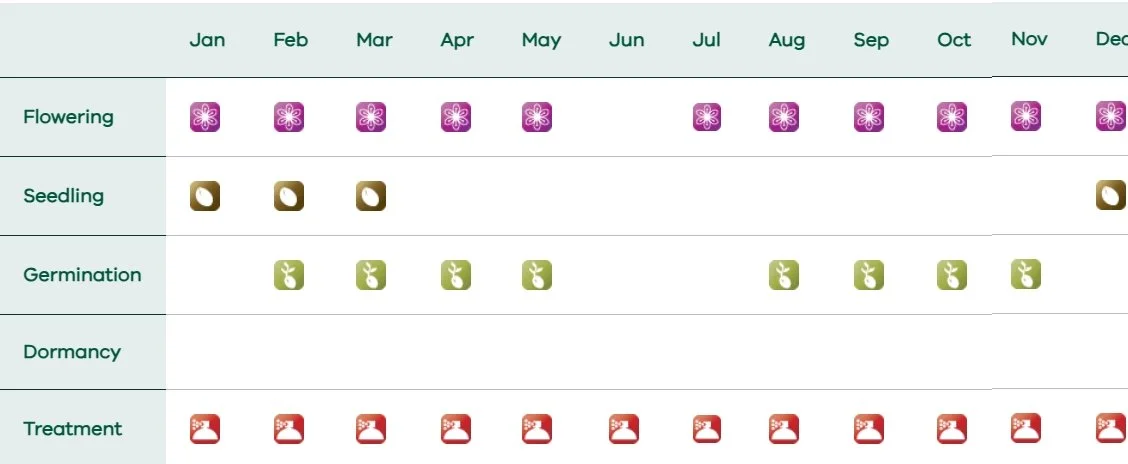
Germination mainly occurs in autumn and spring, seedlings can flower at about 18 months old, plants can live several decades, and flowering and seeding often occur in two main periods (spring and autumn) with some year‑round flowering in mild climates.
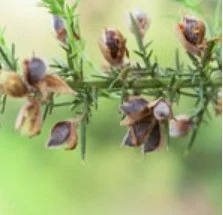
Fruit of gorse is in a fine, densely-hairy oblong pod 10 to 20mm long by 6mm deep. The pods are green when they are young, turning into a dark brown pod when mature. The pods each contain 2 to 6 seeds.
Gorse seed is 3 to 4mm across with a very hard green or brown seed coat and a white or yellow appendage.
Management and Control
Effective control demands sustained, integrated measures (mechanical removal, herbicide programs, biocontrol, follow‑up and community coordination).
Weeds of National Significance (WONS) - YES
High seedbank longevity (30–50+ years) and prolific seed production mean control is ongoing and expensive at landscape scale. Regional eradication or containment programs and statutory control enforcement create recurring public and private expenditure.
When mature flowering plants are removed, many seedlings will germinate from the soil seed bank and follow-up is critical. Integrated control methods combining techniques, with long term follow-up, is advised for success. Tackle the small, outlying infestations first. This allows a bigger area of land to be cleaned up first and there will be less follow-up maintenance in these areas as the seedbank will be smaller.
Chemical control
Herbicides can be applied either directly to leaves when plants are at least 500 mm high or by cut-stump treatment (cut and swab; cut and paint or cut stump methods), where the plant is cut off just above ground level and herbicide is applied to freshly cut stump.
Sprays should not be applied when plants are in full flower or when bees are active.
A number of herbicides are available for use on Gorse (DPIW 2002; CRC 2003). Foliar sprays normally require complete coverage of actively growing plants, used with a wetting agent, and the plant must be allowed to die over a long period before being removed or burnt. Please see the Australian Pesticides and Veterinary Medicines Authority for chemical information http://www.apvma.gov.au.
Non-chemical control
Physical control: Hand pulling is only possible with small plants and seedlings, normally when the soil is damp and soft allowing easy removal. This is normally used after mature plants have been removed and results in subsequent germination of many seedlings. Mechanical control by clearing is a useful method of controlling large infestations of Gorse using bulldozers or tractors to rip and bulldoze the populations. Regular slashing or mowing is not effective in eradicating Gorse as plants will grow back vigorously once slashing stops (CRC 2003).
Competition and management: Grazing by sheep is moderately effective for controlling Gorse seedlings before spines are formed but high stocking rates are needed to force sheep to graze on Gorse rather than other pasture species. Grazing needs to be carefully managed to avoid overgrazing and subsequent pasture damage. Burning is often carried out in combination with grazing as it reduces the amount of leaves and stems and stimulates growth of soft green shoots, which are initially spineless and more palatable to stock (CRC 2003).
Cultivation: In agricultural situations where stands of gorse has been removed, cultivation with plough can disturb and kill underground roots and is useful for follow-up treatment for killing any regrowth and seedlings. However, some fragments may regrow. Cultivation in cropping is also effective at killing seedlings.
Mulching: Can be used to to suppress seedling germination but will not be effective for repressing or killing mature plants cut off at ground level.
Fire: Fire can also be useful in reducing dense thickets of Gorse to ground level to allow follow-up with animals or spraying of regrowth and to stimulate seed germination, allowing more seedlings to be sprayed the following year and reducing the seedbank (CRC 2003).
Biological control: Several biological control organisms have been released, including the Gorse Seed Weevil Exapion ulicis, Gorse spider mite Tetranychus lintearius, and Gorse Thrips Sericothrips staphylinus, all with some but limited success. Another thrip (same genus) of Portuguese origin is being reared for field release. A further two agents, a pod moth and soft shoot moth, are also under investigation for potential release into Australia (CRC 2003).
Links to further information
Click here to send a request to add a new link
Videos - Control Methods
Videos - General Info
Government Information
**Page Information from various sources within the links above